

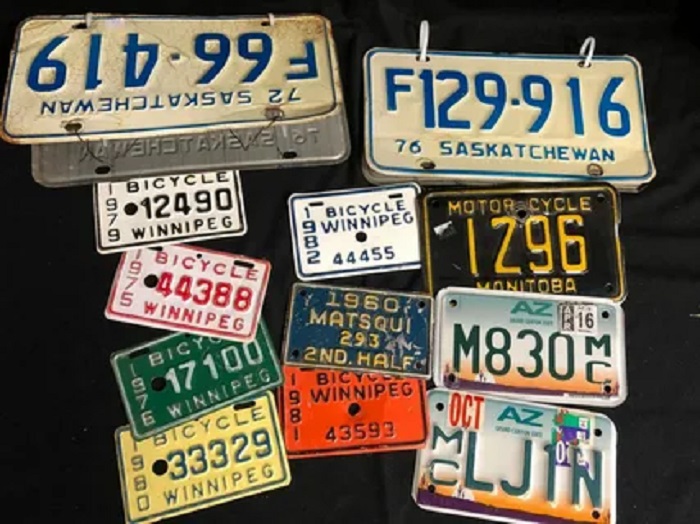
Line up a Dutch plate, a Texas plate, a Japanese plate, and a Saudi plate on the same wall and you would struggle to believe they serve the same function. One is bright yellow. One has a picture of a landscape behind the numbers. One combines a hiragana character with a three-digit class code. One runs Arabic and Latin script side by side.
They all answer the same question, which is who is responsible for this vehicle. They just arrived at wildly different answers about how to do it.
Bureaucracy came first
The earliest registration systems were local. Cities and provinces issued their own numbers, and for a while drivers made their own plates, painting numbers onto leather or metal at home. That worked until it did not. As cars crossed borders, police needed to identify vehicles from other jurisdictions, and the patchwork became unworkable.
Europe centralized relatively early. National registries absorbed local ones, standard fonts and dimensions arrived, and by the 1990s the EU had agreed on a common plate size and the blue identification band on the left edge. That band is the reason European plates look like a family.
North America never centralized. Registration stayed with the states and provinces, and it remains there. The result is a system where fifty different agencies design fifty different plates, refresh them every few years, and treat the plate as a piece of state branding as much as an identifier.
Color is a language
Where plate colors are standardized, they usually carry meaning.
The Netherlands went yellow in 1978 for visibility. India uses color to sort vehicles by use, with white for private, yellow for commercial, and green for electric. Many countries mark temporary and export registrations in red. Taxis, buses, and trailers frequently get their own backgrounds.
The US does almost none of this at the national level. A green plate in one state is a passenger car and in another it might be a specialty series supporting a wildlife fund. Color communicates state identity rather than vehicle class.
Fonts are a security feature
Plate typefaces are not chosen for style. Germany’s FE-Schrift was designed specifically to defeat tampering, with character shapes that cannot be easily modified into other characters. The gap in the number eight, the open shapes, the irregular stroke widths, all of that exists to stop someone turning a 3 into an 8 with a strip of tape.
The UK standardized on the Charles Wright typeface for similar reasons. Several countries have added holograms, embedded microchips, or laser-etched security codes over the last two decades.
Anyone cataloguing these differences quickly discovers there is no single authoritative source, which is the gap a world license plates reference project sets out to fill by documenting formats, region codes, and design histories country by country.
Scripts and the bilingual problem
Countries that do not use the Latin alphabet face a practical dilemma. A plate in Arabic script alone is unreadable to a foreign officer. A plate in Latin script alone is unreadable to a portion of the local population.
Most solved it by using both. Saudi Arabia, the UAE, and Egypt run Arabic numerals and Latin numerals together on the same plate. Japan keeps its plates primarily in Latin numerals with a hiragana character marking the vehicle’s use category and a kanji place name identifying the issuing office. Greece uses only the letters that appear in both the Greek and Latin alphabets, so a Greek plate is legible either way.
Where it is heading
Several trends are converging. Digital plates using electronic ink have been approved in a handful of US states, allowing remote updates and theft flags. Automated number plate recognition has become standard infrastructure for tolls, congestion charging, and low emission zones, which pushes designers toward machine readability over human readability.
Both trends point the same direction. The plate is becoming less a physical label and more a visible index into a database. The design still matters, but mostly to the camera.
The part worth remembering
A plate is a compressed history of how a country thinks about vehicles. Centralized or local, public identifier or private property, transferable or fixed to the car, decorated or strictly functional. Every one of those choices reflects a decision someone made about the relationship between the driver and the state.
Next time you are stuck in traffic abroad, read the car in front of you. It says more than you would think.