

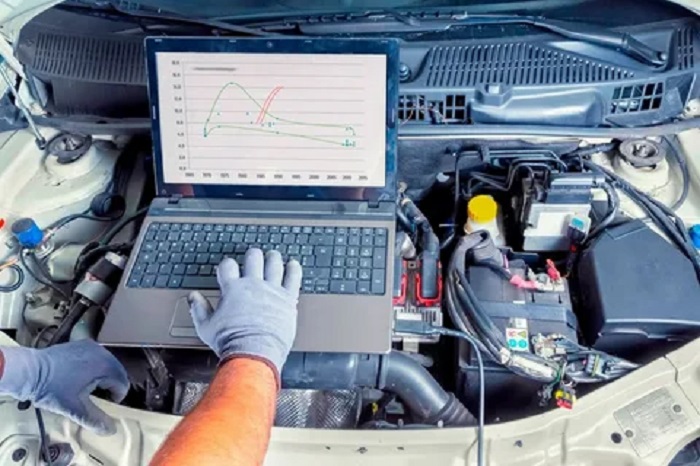
Modern vehicles have evolved far beyond purely mechanical machines. Today, almost every major system in a car is controlled or monitored electronically, from engine management and transmission operation to braking, emissions, safety systems, and driver-assistance technologies.
For automotive workshops and professional technicians, this has fundamentally changed the repair process. Mechanical knowledge remains essential, but accurate diagnosis increasingly depends on having access to the right software, interfaces, and technical information.
This is why professional vehicle diagnostic software has become one of the most important tools in a modern workshop.
Modern Cars Are Complex Computer Networks
A current-generation vehicle can contain dozens of electronic control units communicating over networks such as CAN bus.
Depending on the model, these modules may control:
- Engine operation
- Automatic transmission
- ABS and stability systems
- Airbags
- Climate control
- Body electronics
- Immobilizer and security systems
- Steering
- Battery and charging systems
- Diesel emissions equipment
- Advanced driver-assistance systems
When a warning light appears, the problem may therefore involve considerably more than a single faulty component.
A diagnostic trouble code provides a starting point, but professional troubleshooting requires technicians to understand what is happening throughout the vehicle.
Why a Basic Code Reader Is Not Always Enough
Affordable OBD-II scanners are useful for vehicle owners and basic troubleshooting. They can read many common engine fault codes and provide limited live data.
Professional workshops, however, frequently need much deeper access.
Dealer-level diagnostic platforms can provide functions such as live parameter monitoring, actuator testing, module identification, service procedures, adaptations, calibrations and other manufacturer-specific capabilities.
For technicians working across multiple vehicle brands, access to suitable automotive diagnostic software can make it possible to investigate problems using tools designed for specific manufacturers and vehicle systems.
The difference becomes particularly important when diagnosing faults that cannot be identified simply by reading a generic OBD code.
Live Data Can Tell the Real Story
One of the most powerful capabilities of professional diagnostic software is live-data monitoring.
Suppose a vehicle has poor acceleration.
A generic scanner may display a fault code, but that doesn’t necessarily identify the actual cause.
A technician may need to examine:
- Fuel pressure
- Boost pressure
- Air-flow measurements
- Throttle position
- Injector corrections
- Engine temperature
- Oxygen-sensor values
- DPF pressure
- Battery voltage
- Transmission parameters
Looking at these values together can help determine whether the problem originates from a sensor, wiring, fuel system, turbocharger, mechanical component, or another subsystem.
This is where diagnostics becomes more than simply reading codes.
Manufacturer-Specific Software Provides Deeper Access
Vehicle manufacturers develop their own diagnostic environments because every brand has different electronic architectures, procedures, and control systems.
Examples include platforms used for Mercedes-Benz, BMW, Volkswagen Group vehicles and many other manufacturers.
Independent workshops that regularly service a particular brand can benefit significantly from manufacturer-specific diagnostic capabilities.
Instead of relying entirely on generic fault descriptions, technicians gain access to more detailed information about the systems installed in the vehicle.
Professional dealer diagnostic software and tools can therefore complement universal diagnostic scanners in workshops that require deeper vehicle access.
Diagnostics Should Follow a Process
Professional diagnosis should not become a process of replacing parts until a warning light disappears.
An efficient workflow normally starts by understanding the customer’s complaint and vehicle history.
The technician can then perform a complete diagnostic scan and document the fault codes before clearing anything.
Next comes analysis.
Live data, electrical measurements, technical information and component testing can be used to determine whether the suspected component is actually responsible for the problem.
A structured process might look like this:
Customer complaint → complete vehicle scan → fault analysis → live-data testing → technical verification → repair → final scan and road test.
This approach can save both the workshop and customer considerable time and money.
Diagnostic Software Can Improve Workshop Productivity
Correct diagnosis isn’t only about technical accuracy.
It’s also an economic issue.
Imagine two workshops receive the same vehicle.
The first workshop spends several hours replacing components based on fault codes and internet searches.
The second technician has access to appropriate diagnostic software, service information and test procedures and identifies the underlying problem considerably faster.
Even if both eventually repair the vehicle, the second workshop uses its labor more efficiently.
Across hundreds of vehicles per year, that difference becomes significant.
Better diagnostic capability can help workshops reduce unnecessary parts replacement, shorten troubleshooting time and handle more complicated repairs internally.
Service Functions Are Becoming Increasingly Important
Modern diagnostic platforms aren’t limited to troubleshooting faults.
Many vehicles require electronic procedures even during routine maintenance.
Depending on the manufacturer, diagnostic software may be required for functions such as:
- Electronic parking-brake service
- Steering-angle calibration
- Battery registration
- Injector coding
- DPF service procedures
- Transmission adaptations
- Service resets
- Component activation
- Module initialization
This means diagnostic equipment is increasingly required even for jobs that were once almost entirely mechanical.
As vehicle technology continues to evolve, this trend is likely to accelerate.
The Importance of Correct Technical Information
Diagnostic software provides access to the vehicle, but technicians still need accurate information to interpret what they see.
A fault code alone doesn’t tell a technician whether the problem is caused by a component, connector, wiring harness, power supply, software issue, or another related system.
Professional troubleshooting may therefore combine diagnostic software with wiring diagrams, specifications, service procedures and manufacturer documentation.
This combination is particularly valuable when dealing with intermittent or complicated electrical faults.
Choosing Diagnostic Tools for a Workshop
There isn’t one diagnostic solution that is perfect for every workshop.
A small independent garage servicing passenger cars has different requirements from a specialist working predominantly with one manufacturer.
Before investing in diagnostic equipment, workshops should consider:
Vehicle coverage. Which manufacturers represent most of the workshop’s customers?
Diagnostic depth. Is basic code reading sufficient, or are manufacturer-level functions required?
Hardware compatibility. Which interfaces are required for the software?
Technical support. Can assistance be obtained with installation and configuration?
Computer requirements. Some professional diagnostic applications require particular Windows versions, storage capacity, memory or hardware configurations.
These considerations become especially important when operating multiple diagnostic platforms.
Dedicated Diagnostic Laptops Can Simplify the Workshop
Installing numerous professional diagnostic applications on ordinary office computers can create compatibility and configuration problems.
For workshops supporting multiple brands, a dedicated diagnostic laptop can provide a cleaner solution.
A properly configured workstation can keep the required diagnostic applications, drivers and interfaces organized in one environment.
Diagsoft provides professional diagnostic laptops and software solutions for workshops and technicians working with cars, trucks and equipment from multiple manufacturers.
This type of setup can be particularly useful for independent workshops that want broader diagnostic coverage without maintaining numerous separate computers.
Vehicle Repair Will Continue Becoming More Software-Driven
The automotive industry is moving toward even greater electronic integration.
Hybrid and electric powertrains, advanced driver-assistance systems, connected vehicles and increasingly sophisticated control modules are making software an essential part of automotive repair.
That doesn’t reduce the importance of skilled mechanics.
It changes the tools those mechanics need.
The successful technician increasingly combines traditional mechanical knowledge with electronics, data interpretation and professional diagnostic software.
Final Thoughts
Modern vehicle diagnostics is no longer simply a matter of connecting a scanner and reading a fault code.
Professional troubleshooting requires understanding how multiple electronic systems interact, analyzing live vehicle data and using appropriate manufacturer-specific tools when necessary.
For independent workshops, investing in the right professional diagnostic Tools can improve diagnostic accuracy, reduce unnecessary parts replacement and help technicians repair increasingly complex vehicles more efficiently.
As vehicles continue becoming more software-controlled, strong diagnostic capabilities will become an even more important competitive advantage for professional automotive workshops.