

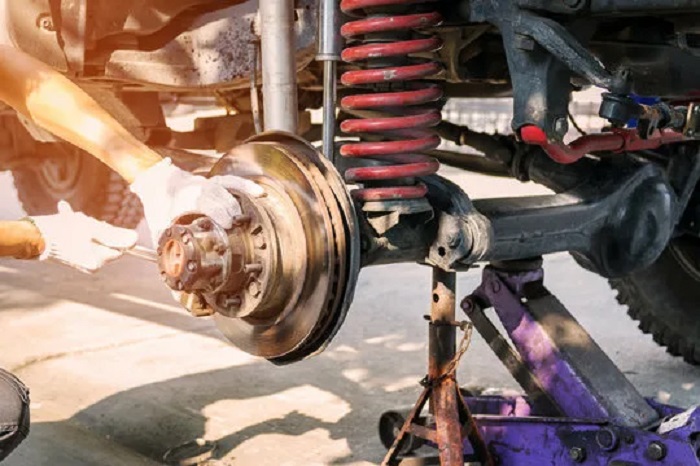
The suspension is responsible for vehicle stability, comfort, and safety: it dampens vibrations, maintains tire contact with the road, and helps maintain control when cornering and braking. Any play, knocking, or uneven wear quickly translates into increased braking distance and reduced steering response.
A proper suspension diagnosis on UnlimBoost begins with documenting the symptoms and sequentially inspecting components: from tires and fasteners to joints and shock absorbers. This approach saves time and money because it allows you to find the root cause, rather than “treating” the consequences by replacing serviceable parts.
When diagnostics are needed: signs of malfunction
Most often, the suspension “sends signals” in advance. It’s important not to ignore even rare symptoms, because wear usually progresses and affects adjacent components.
- Knocks and clunks on small bumps, speed bumps, and when driving over potholes.
- The car pulls to one side when driving straight or braking.
- Steering that is unstable, requiring constant steering correction.
- Vibrations in the steering wheel or body that increase with speed.
- Uneven tire wear (notchy, along the inner/outer edge, in patches).
- Body dive/sway, suspension breakdown, springing after bumps.
- Leaks in the shock absorbers, cracks in the silent blocks, damage to the anthers.
What are the symptoms? Vehicle behavior often indicates problems with the suspension and related chassis components before any visual signs. It’s important to note changes in handling, stability, braking, and noise levels, rather than waiting for a malfunction to lead to a breakdown or accident.
If symptoms occur regularly or worsen, it’s best to limit use and have the vehicle diagnosed as soon as possible: a faulty chassis accelerates tire wear, increases braking distances, and reduces vehicle predictability.
Main Signs of Malfunction Based on Vehicle Behavior
- Vehicle pulling to one side when driving on a level road (especially when accelerating or braking) – possible problems with wheel alignment, worn bushings, ball joints, tie rod ends, or different spring stiffness.
- Instability at speed, drifting in the lane, and the need for constant steering corrections – play in the steering, worn stabilizer bushings/struts, shock absorbers, and struts struts.
- Excessive roll when cornering, delayed steering response – indicates worn shock absorbers, springs, faulty anti-roll bar, or its mountings.
- Dive when braking and “squat” when accelerating – indicates reduced shock absorber effectiveness, weakened springs, and possible body distortion.
- Suspension bottoming out on uneven surfaces, hard impacts to the body – indicates worn shock absorbers, bump stops, springs, or damaged silent blocks; Risk of damage to supports and fasteners.
- Extraneous sounds (knocking, creaking, crunching) when driving over potholes, speed bumps, or when turning the steering wheel often indicate problems with ball joints, stabilizer struts/bushings, thrust bearings, silent blocks, or loose fasteners.
- Vibrations in the steering wheel/body that increase with speed can be caused by wheel imbalance, disc deformation, or wear of wheel bearings, CV joints, or suspension components; It is important to exclude the chassis if there are repeated vibrations.
- Changes in steering effort, sticking, or clicking when turning – these may indicate problems with the support bearings, tie rod ends/rods, joints, or suspension geometry after an impact.
- Increased braking distance and instability when braking on uneven roads – the wheels have less contact with the wheels due to shock absorbers, play, and distorted geometry; the risk of skidding increases.
- Uneven tire wear, “saw-like” wear, worn edges, and wear spots – these indicate problems with the wheel alignment, play in the control arms/silent blocks, and hub assemblies; Often accompanied by pulling and noise.
Bottom line: any recurring changes in stability, handling, noise, vibration, and suspension performance are a clear reason to diagnose the chassis. The sooner a worn component is identified and the cause (not just the symptom) is addressed, the lower the repair costs and the greater the driving safety.